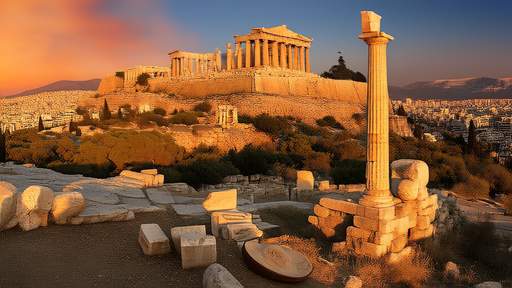
Climbing to the top of the Acropolis of Athens, the birthplace of democracy, has always been a feat for the brave. Never more so, perhaps, than in recent summers when the city has sweated through long and perilous heatwaves. In the past two years, during peak tourism season, relentless heat has repeatedly forced authorities to shut Greece’s most-visited site during the hottest hours of the day to protect visitors and staff from temperatures exceeding 40 Celsius (104 Fahrenheit). The UNESCO World Heritage site has little shade. Standing among the exquisitely-crafted white marble columns of the Parthenon as they reflect the fierce Mediterranean sun can feel more like an endurance test than the fulfillment of a childhood dream — especially when the smoke from out-of-control wildfires drifts across the horizon.
And it’s not just the Acropolis. Athens has always been scorching in the summer, but never to current levels. It’s the hottest capital in mainland Europe but witnessed record highs in 2024, a situation that’s becoming the new normal. The Mediterranean as a whole is warming up faster than the global average. With travel to Greece booming, officials say Athens is forecast to welcome a record 10 million visitors this year. Those arriving in July and August will be on a collision course with yet more extreme temperatures, predicts the country’s national weather service, creating a perfect storm of tourism and scorching weather.
The situation has raised existential questions for Greece and its relationship with the visitors whose spending power has helped the country out of crisis during financially turbulent times. Increased tourism means increased pressure on scarce water resources and infrastructure. It also means inflation, pushing locals out in favor of wealthy incomers. A much-talked-about opinion article in the Greek press suggested that the country’s single-minded pursuit of maximum tourism no longer made sense, and that Greeks were in danger of losing their birthright. “Starkly put, we are bequeathing the subsequent generations of Greeks not just a massive pile of debt, but also a summerless Greece,” it said.
Trepidation about the months ahead, when the sun will once again bake down, is high. And yet, amid the fear, there is certainly hope — and a realization that the country must adapt or face disastrous consequences. For the mayor of Athens, Haris Doukas, “building resilience is a matter of survival.” Managing those high temperatures alongside the surge in summer tourists has become a priority. In the short-term, that means early-warning systems for heatwaves and real-time monitoring of temperature data, along with fountains, air-conditioned cooling centers, and shady pocket parks are all in place to provide relief. Emergency services have been put at the ready, including around the foothills of the Acropolis, to assist visitors experiencing discomfort.
“Tourists often underestimate the heat, especially those from colder climates,” says Iris Plaitakis, a tour guide who regularly visits the Acropolis. “They don’t think to wear hats or bring enough water. You’re much more exposed to the sun and heat up there because of the higher elevation and lack of trees and other shade.” Extreme heat is incredibly dangerous. “Heatwaves are responsible for more than 80% of deaths caused by weather and climate events in Europe,” says Ine Vandecasteele, a European Environment Agency urban adaptation expert.
In the longer term, Athens faces the challenge of reshaping a city that has become a concrete heat sink with limited green spaces — it’s one of the least green cities in Europe and the second-most densely populated after Paris. To complicate things, Greece, and Athens in particular, is home to one of the oldest populations in Europe, a demographic at risk from extreme heat. In 2021, the city became Europe’s first to appoint a dedicated “chief heat officer” to promote and coordinate adaptation and resilience strategies, as it began focusing on nature-based solutions to reduce the heat-island effect, which sees cities becoming much hotter than the surrounding natural environment.
“In just over a year we have planted 7,000 trees, which is difficult in such a densely built city. We want that number to reach 28,000 in four years. We are also establishing green corridors,” says Doukas, the Athens mayor. “Athens is rethinking urban infrastructure, redesigning roads and selecting heat-absorbing materials.” Resilience-building initiatives include the creation of detailed heatwave maps that enable targeted interventions. Among them is the creation of a microforest, Greece’s first, in Kypseli, Europe’s most densely populated neighborhood. “The goal is to lower perceived temperatures by 5 degrees Celsius within five years by creating targeted microclimates,” says Doukas.
In the leafy Chalandri suburb, the revitalization of a second-century Roman aqueduct to irrigate green spaces and cool neighborhoods has gained much attention. “The aqueduct transports water that would otherwise go to waste,” says project manager Christos Giovanopoulos. “When the new pipelines are operational this summer, we’ll save 80,000-100,000 cubic meters annually.”
Heavily built up and covered in graffiti, modern Athens bears little resemblance to the idyllic location people chose to settle millennia ago. Back then it offered proximity to both mountains and the sea, a mild climate, verdant and abundant resources, and flowing rivers — the same waterways that were concreted over during rapid urbanization in the 1950s and 1960s to build highways. And some of that concrete will now have to go, says Juanjo Galan, an associate professor of urban planning at Spain’s Technical University of Valencia, who has watched his own city undergo a green revolution, being named European Green Capital 2024 for its achievements in green transition and climate neutrality.
“In Spain, we say you cannot make an omelet without breaking some eggs,” says Galan. “Like Valencia, Athens will have to break some concrete, invest in green infrastructure, and heat-absorbing materials. It will take some time but can be done.”
One major project already underway is reconnecting Athens with the sea that defines so much of life in the rest of Greece. With enchanting ancient wonders and picturesque jasmine-scented alleyways in its historic center, it is easy for visitors to forget that Athens is actually very close to the Greek coast and many beautiful coves and beaches. Athenians have always known this, often heading out of town to cool down. And now their city is following suit, expanding along the waterfront, revamping an area recently branded The Athens Riviera.
Stretching south 50 kilometers (about 30 miles) from the main port of Piraeus, the coastline is home to organized beaches, quality restaurants, and five-star hotels and resorts. It is also where the country’s largest-ever urban green transformation is taking place at Ellinikon, Athens’ decommissioned former airport. The 600-acre mixed-use private development will include Greece’s first skyscraper — the 50-floor Riviera Tower, which will house luxury sea-view apartments. At the heart of the project is the Ellinikon Park. Projected to become the largest green area in Athens and one of the biggest coastal parks in the world, it’s expected to attract a million tourists annually.
The role of tourists in Athens’ future is a contentious issue. On one hand, they’re seen as a lifeblood. During the 2010s, when Athens was the epicenter of a painful financial crisis that saw Greece’s GDP slashed by a quarter, it was tourism that brought the economy back. On the other hand, Athenians have found themselves increasingly priced out by gentrification partly driven by tourism, and are concerned about the impact of the industry on a city stretched to the limits by extreme heat. Real estate prices along the coast have hit the roof, with many prime Athens properties now in the hands of big international investors and others transformed into boutique hotels and global luxury chains that pull in more visitors. Those same hotels are installing air conditioning and swimming pools to keep their guests cool in a city with already stretched power and water supplies.
Many Athenians are anxious about the summer ahead, with official reports about falling reservoir water levels regularly making the TV news. The situation is exacerbated by the extensive wildfires that have destroyed 40% of forested areas around their city in less than a decade — the blazes fanned by similar, windy conditions seen in the recent Los Angeles fires and, like in LA, worsened by man-made climate change. Meanwhile, with tourism still a key economic driver, Greece must continue to tap the industry while trying not to get burned. And despite the challenges facing Athens and the rest of the country, tourists are expected to keep coming. A record 36 million came in 2024, over three times the country’s population. Data analysts Fitch Solutions say the number is expected to hit 40 million by 2030.
“People come from all over the world to understand, and experience, the cradle of Western civilization, to see where Aristotle and Plato walked, where the first modern Olympics were held,” says Plaitakis, the archaeological guide. “This cannot be recreated. And it will always bring people to Athens.”
As with other overtouristed destinations around the world, Athens is hoping to try to funnel some of its peak summer-season tourism into shoulder or even off-peak times. Mild temperatures in spring and early fall present an ideal opportunity to explore the city’s landmark sites, vibrant art scene, and fun-loving, laid-back culture. And with colder months also becoming milder, Athens is a growing winter destination, mostly for northern Europeans, hungry for olive-oil-drenched Greek-salad-and-moussaka days and fresh-fish-and-ouzo nights.
Athens’ efforts to keep cool can already be seen. In the historic center, tourists are learning to drink their iced coffee like locals, nice and slow — a cooling companion to see them through the hottest part of the day. At information points, smiling young women advise tourists, in polished English, to purchase tickets to the Acropolis in advance to avoid long lines and the midday sun. If the Acropolis is temporarily off-limits due to extreme heat, Plaitakis suggests heading to “the top three” as a cooler option: The Acropolis Museum, the National Archaeological Museum, and the Museum of Cycladic Art.
To take in some coastal views, she advises starting at the Stavros Niarchos Foundation Cultural Center, designed by the great Renzo Piano, and stopping for a dip and a Greek taverna lunch at one of the many beaches on the way to the magnificent Temple of Poseidon, a sunset destination. As daylight dwindles, and temperatures cool down, the city’s energy rises around an outdoor culture that features open-air cinemas, live performances, and a vibrant nightlife. Greeks are famously late-night eaters and known to occupy every available space at bars, beaches, and benches waiting for their city to cool down. A form of climate adaptation by default. A Mediterranean way of life that needs to up its game in a time of climate emergency.
By William Miller/Jun 4, 2025
By Christopher Harris/Jun 4, 2025
By Samuel Cooper/Jun 4, 2025
By Sophia Lewis/Jun 4, 2025

By Eric Ward/Jun 4, 2025
By Amanda Phillips/Jun 4, 2025
By Samuel Cooper/Jun 4, 2025
By Natalie Campbell/Jun 4, 2025
By Samuel Cooper/Jun 4, 2025
By Grace Cox/Jun 4, 2025
By David Anderson/Jun 4, 2025
By Jessica Lee/Jun 4, 2025
By Emma Thompson/Jun 4, 2025
By Grace Cox/Jun 4, 2025