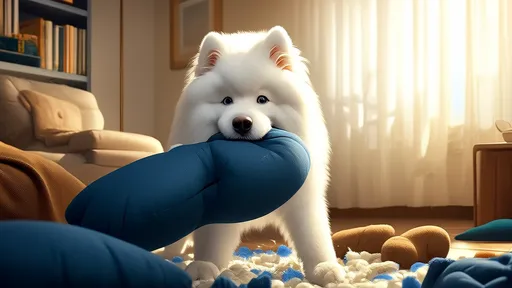
The sight of a fluffy Samoyed gleefully disemboweling a couch cushion or reducing a throw pillow to snowdrifts of fluff might elicit equal parts amusement and exasperation. Behind those trademark "Sammy smiles" and innocent eyes lies a breed-specific compulsion that puzzles many owners: the systematic destruction of soft household items. This behavior, far from random mischief, reveals a fascinating intersection of canine psychology and evolutionary adaptation in Arctic working dogs.
The Oral Fixation of Snow Dogs
Veterinary behaviorists have long noted that Northern breeds—particularly Samoyeds, Huskies, and Malamutes—exhibit prolonged oral-stage behaviors compared to other dogs. Where most puppies outgrow mouthing tendencies by six months, these powder-puff demolition experts may continue seeking oral satisfaction through fabric destruction well into adulthood. The key lies in understanding what ethologists call "behavioral neoteny"—the retention of juvenile traits into maturity.
In the merciless Arctic environment where Samoyeds evolved, survival depended on constant chewing. Puppies learned to gnaw frozen hides to access nutrients, tear windproof insulation for bedding, and chew sled lines to prevent dangerous tangles. Modern central heating and plush dog beds haven't erased this genetic memory. When a Samoyed methodically de-stuffs a $200 down comforter, they're essentially following an ancient adaptive program that once meant the difference between life and death on the tundra.
The Psychology of Fluff-Based Destruction
Canine cognitive researchers identify three reinforcing elements in Samoyeds' fabric destruction: tactile satisfaction from tearing fibrous materials, the rewarding challenge of extracting stuffing (simulating prey-gutting behaviors), and the comforting oral sensation of carrying soft debris. This explains why punishment typically fails—the behavior is neurologically self-rewarding. The dog isn't being "disobedient"; they're fulfilling a deeply ingrained need.
Interestingly, the choice of victims follows predictable patterns. Items retaining human scent (worn clothing, bedroom pillows) are preferentially targeted, suggesting an element of social bonding. Temperature also matters—Samoyeds show greater interest in materials that retain warmth, echoing their ancestral preference for insulating materials. The destruction sequence itself is remarkably methodical: initial testing bites to assess material resistance, focused tearing at structural weak points, then meticulous extraction of contents.
Compensating for Lost Winters
Modern Samoyeds exist in a perpetual state of environmental mismatch. Bred for subzero temperatures yet living in climate-controlled homes, their biological wiring remains adapted to conditions they never experience. The act of shredding fluffy items may represent an unconscious attempt to recreate snow-related activities—burying their muzzle in stuffing mimics snow-nosing for prey, while the scattering of debris approximates pawing through drifts.
Behavioral therapists note increased destruction during warmer months, possibly correlating with decreased opportunity for temperature-regulating behaviors. Some owners report success with "snow simulation" interventions: freezing towels for chewing, creating indoor digging pits filled with shredded paper, or providing ice blocks containing treats. These outlets allow expression of natural behaviors in domesticated contexts.
Rethinking Discipline and Enrichment
Traditional obedience training often backfires with Samoyeds, as their independent sled-dog mentality interprets confrontation as a challenge. Behavior modification requires channeling rather than suppressing their oral needs. Successful approaches include:
- Providing destruction-approved items like unstuffed plush toys with internal compartments
- Implementing scheduled "destruction time" with sacrificial items
- Incorporating shreddable materials into foraging toys
- Teaching alternative oral behaviors like carrying objects during walks
The most effective solutions acknowledge this isn't a behavior to eliminate, but rather an intrinsic characteristic requiring mindful management. As one sled-dog behavior specialist notes: "You can't take the Arctic out of the Samoyed—nor should you want to. Our job isn't to stop their natural behaviors, but to give them appropriate outlets in our human world."
Understanding this psychological compensation transforms frustration into appreciation. That disemboweled pillow isn't household vandalism—it's the modern manifestation of ancient Arctic survival strategies, a snowy heritage expressed through suburban living. With proper outlets, Samoyed owners can preserve their homes while honoring their dog's evolutionary legacy, turning potential conflicts into opportunities for species-appropriate enrichment.

By /Jun 12, 2025

By /Jun 12, 2025

By /Jun 12, 2025

By /Jun 12, 2025

By /Jun 12, 2025

By /Jun 12, 2025

By /Jun 12, 2025

By /Jun 12, 2025

By /Jun 12, 2025

By /Jun 12, 2025

By /Jun 12, 2025
By /Jun 12, 2025

By /Jun 12, 2025

By /Jun 12, 2025

By /Jun 12, 2025

By /Jun 12, 2025

By /Jun 12, 2025

By /Jun 12, 2025
By /Jun 12, 2025