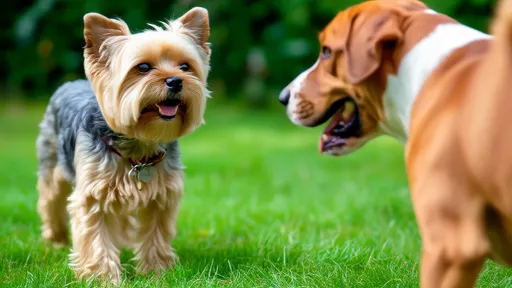
The Yorkshire Terrier, affectionately known as the Yorkie, is one of the smallest dog breeds in the world, often weighing no more than seven pounds. Despite its tiny stature, this breed has gained a reputation for its fearless—and sometimes aggressive—behavior toward much larger dogs. This puzzling phenomenon has left many dog owners and animal behaviorists scratching their heads. Why would a dog so small willingly confront a canine ten times its size? The answer may lie in a fascinating combination of evolutionary instincts, misjudged threats, and defensive communication strategies.
The Illusion of Size: A Yorkie’s Perspective
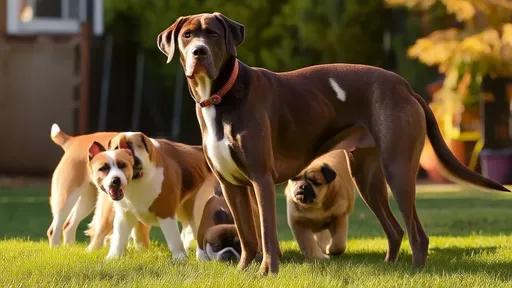
To understand why Yorkies often challenge larger dogs, we must first consider how they perceive the world. Due to their diminutive size, Yorkies live in an environment where almost everything appears enormous. From furniture to humans, their daily experiences are dominated by towering figures. This constant exposure to "giants" may desensitize them to size differences, making them less intimidated by big dogs. In other words, a Great Dane might not seem significantly more threatening than a Labrador to a Yorkie—both are just "big."
This desensitization can lead to a critical error in judgment. When a Yorkie encounters a larger dog, it may not fully comprehend the potential danger. Unlike medium-sized dogs, which often display caution or submission toward larger breeds, the Yorkie’s perception of scale is skewed. This misjudgment can result in the little dog initiating confrontations it cannot possibly win, purely because it doesn’t recognize the imbalance in power.
The Defensive Roar: More Than Just Bark
Another key factor in this behavior is the Yorkie’s defensive vocalization. Small dogs, particularly terriers, are known for their loud, high-pitched barks—a trait that serves as an evolutionary defense mechanism. In the wild, smaller animals often rely on startling noises to deter predators. A sudden, sharp sound can buy precious seconds for escape or even discourage an attacker altogether. For Yorkies, this instinct translates into what owners often describe as "yapping" or "nagging" at larger dogs.
However, this isn’t just random noise. Research suggests that small dogs use specific tonal patterns in their barks to communicate different levels of threat. A Yorkie’s rapid, high-frequency barking is designed to sound more aggressive than it actually is—a bluff to convince a larger opponent that the tiny dog is not worth the trouble. This tactic sometimes works, especially if the bigger dog is well-socialized and non-confrontational. But when faced with a truly dominant or reactive dog, the strategy backfires spectacularly.
The Role of Human Reinforcement
Human behavior plays a significant role in reinforcing this defensive aggression. Many owners of small dogs inadvertently encourage bold behavior by laughing it off or dismissing it as "cute." A Yorkie that growls at a passing Mastiff might receive affectionate praise from its owner, reinforcing the idea that such behavior is acceptable—or even rewarded. Over time, this positive reinforcement can amplify the dog’s tendency to challenge larger breeds.
Additionally, small dogs are often picked up or shielded by their owners when a larger dog approaches. While this is done out of concern for the Yorkie’s safety, it can create a false sense of invincibility. The dog learns that aggressive displays lead to protection, further entrenching the habit. Unlike big dogs, which are typically trained to avoid aggression due to the real physical risks they pose, small dogs face fewer consequences for their boldness, allowing the behavior to persist.
Terrier Tenacity: A Breed-Specific Trait
It’s also important to acknowledge the inherent traits of the Yorkshire Terrier breed. Originally bred for ratting—hunting rodents in mines and mills—Yorkies were selected for their courage, energy, and persistence. These qualities made them excellent at their jobs but also contribute to their confrontational tendencies. A Yorkie’s instinct is to stand its ground, even when outmatched. This tenacity, combined with their distorted size perception and defensive barking, creates the perfect storm for small-dog bravado.
Interestingly, this behavior is less common in other small breeds like Cavalier King Charles Spaniels or Shih Tzus, which were bred for companionship rather than hunting. The difference highlights how genetics and historical purpose influence modern behavior. A Yorkie’s aggression isn’t just a quirk; it’s a byproduct of centuries of selective breeding for specific traits.
Managing the Small Dog Syndrome
For Yorkie owners, understanding these dynamics is the first step in managing their pet’s behavior. Training should focus on reinforcing calm, non-reactive responses to larger dogs. Instead of picking up the Yorkie at the first sign of tension, owners can work on commands like "sit" or "leave it" to redirect their dog’s attention. Socialization from an early age is also crucial. A Yorkie exposed to well-behaved big dogs in controlled settings is less likely to see them as threats.
Ultimately, the Yorkie’s tendency to confront larger dogs is a complex interplay of perception, instinct, and learned behavior. While their fearless attitude can be endearing, it’s important to remember that even the bravest Yorkie is no match for a truly aggressive big dog. Responsible ownership—combining proper training, socialization, and an understanding of breed-specific traits—can help mitigate these confrontations and keep both the Yorkie and its larger counterparts safe.

By /Jun 12, 2025

By /Jun 12, 2025
By /Jun 12, 2025
By /Jun 12, 2025
By /Jun 12, 2025
By /Jun 12, 2025
By /Jun 12, 2025
By /Jun 12, 2025
By /Jun 12, 2025

By /Jun 12, 2025

By /Jun 12, 2025

By /Jun 12, 2025

By /Jun 12, 2025

By /Jun 12, 2025
By /Jun 12, 2025

By /Jun 12, 2025

By /Jun 12, 2025
By /Jun 12, 2025

By /Jun 12, 2025
